


Your shopping cart is empty!
Radish "Trio mix" (collection of long varieties) seeds on tape


Raphanus sativus L. var. sativus
3.16€
Ex Tax: 2.54€
Ex Tax: 2.54€
Mixture of popular long-fruited radish varieties of various colours "Trio mix" (seeds on tape).
Radish agrotechnics.
It is simple: seeds are sown dry in the soil to a depth of 1-1.5 cm (with deeper embedding, root crops will be more oval). Radishes are sown in spring, immediately after the snow melts.
Radish is a cold-resistant crop, and the use of covering during its cultivation allows getting earlier products.
The main mistake of most amateur vegetable growers when sowing radishes is excessive overcrowding of seeds. Because of this, the plant often stretches out and does not produce the required number of root crops.
It is best to sow radishes individually at a distance of 5x5 cm. This can be done using a garden marker or by purchasing seeds on tape (by the way, you can make such a tape yourself by gluing seeds onto strips of ordinary newspaper paper with silicate glue).
Radish grows well at moderate temperatures, from +12 to +16°C. At higher temperatures, the plant grows mainly leaves, not the root crop.
Radish reacts sensitively to day length: with a day length of more than 16 hours, the plant does not form a root crop but proceeds to bolting and flowering.
Radish can be grown both as a main crop and as a compactor between rows of carrots, beets, dill, parsley. By the time the main crop rises and develops, it will already ripen, and it is easy to remove from the garden bed.
Harvesting is carried out as root crops form. Usually, they have a diameter of at least 1.5 cm. At the same time, leaf blades are torn off the radish, which evaporate moisture. Without this technique, the root crop becomes limp. Do not delay harvesting radishes, otherwise, by overgrowing, the root crop becomes coarse and flabby.
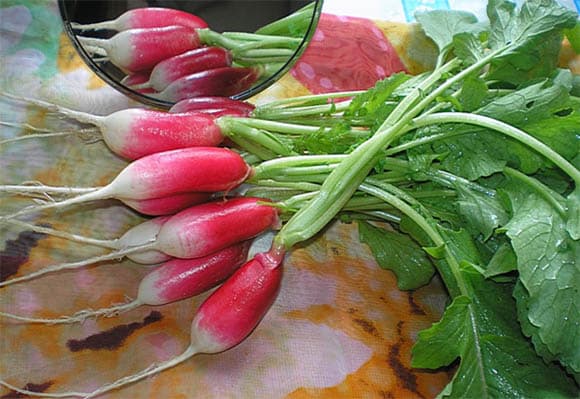
* Radish is one of the most popular early-ripening vegetables. Three harvests of root crops can be collected from the same beds per season.
Loose, moist, fertile soils of neutral or slightly acidic reaction are allocated for radishes. On structureless and nutrient-poor soils, the vegetable does not form a root crop.
Usually, radishes are sown in the ground from April 15 to May 15 and from August 15 to September 1. This is due to the fact that heat and long daylight hours cause it to bolt, although there are varieties that can be grown throughout the garden season (as soon as the ground thaws and until it freezes again) - for example, the "Duro" variety.
When dealing with this crop, do not forget that seeds for sowing should be chosen large and fresh. To get a high yield, they must be sown evenly, shallowly embedded in the soil, since thickened crops do not form root crops.
Radish is cold-resistant but does not tolerate dry and hot weather well: root crops become flabby, bitter.
Radish loves loose soil that absorbs water well and is rich in fertilizers. For the first sowing, it is prepared in autumn and covered with film, and in spring (even before the snow melts), it is cleared and as soon as the ground thaws by about 20 cm, it is loosened and sowing is carried out.
Soil preparation recipe (per 1 m²):
Apply 1 bucket of manure humus, 1 bucket of rotted sawdust (if not available - 1 bucket of sod land and 1/2 bucket of river sand), 1/2 litre of wood ash, 1/4 litre of garden lime (dolomite flour), 1 tablespoon of superphosphate, 1 tablespoon of nitroammophoska, 1 tablespoon of urea and 1 teaspoon of potash fertilizers (potassium chloride or sulphate). All this is evenly scattered over the dug area and dug up again, then levelled with a rake and a bed is formed.
The bed should not be very high and should not be sloping so that water does not flow down from it and does not stagnate, creating puddles.
Sowing is carried out in transverse furrows made with a rod to a depth of 1 cm. A distance of 5 cm is made between the furrows, and 2-3 cm between seeds (or tape is used), then the furrows are covered with the same earth, watered with warm water and covered with covering material (spunbond, lutrasil, etc.).
Usually, before emergence, the bed covered with covering material does not require watering. After the seeds have sprouted, watering is carried out every 1-2 days, and in cold weather less often. When the ovary reaches the size of a large pea, watering must be done daily at the rate of 1-2 buckets per square metre. The more intense the watering, the juicier the radish and the less bitterness. The covering material can be kept on during the entire period of radish cultivation, however, to slow down the growth of tops at the fruiting stage, it is better to open it.
* Radish belongs to short-day plants. It grows better if you switch it to a short day, i.e., cover it with opaque black film or a wooden box from 7 pm to 7-8 am. With this method of cultivation and good watering, radishes can grow up to 10 cm in diameter without losing taste qualities. This should be noted primarily by greenhouse owners.
One of the gardener's biggest disappointments when growing radishes is the flowering of plants. Try an old peasant method. If the radish is preparing to shoot a stalk, press the root crop with two fingers and push it into the soil, patting the rosette with your palm. "Cherished words" would be appropriate here: "Swell up, swell up, but don't you dare bloom!"
With too long a daylight day, radishes can be shaded using this method. Make a removable frame covered with opaque material, for example, roofing felt. The frame is placed at 8 pm and removed at 7 am the next day. Thus, radish plants will have a normal 13-hour daylight day for their development.
And bolting of radishes can also be reduced by constant maintenance of soil moisture in radish beds. The soil must not be allowed to dry out. It is recommended to water radishes in the evenings every 2-3 days, and in drought - daily, morning and evening.
In the first 10 days of radish development, the earth should be soaked to a depth of 8 cm during irrigation, and with the beginning of root formation - not less than 15 cm.
Radish, spinach, and daikon give a good harvest only under short-day conditions, so they can be sown again at the end of summer: in early August in more northern regions, and in Estonian conditions - until August 15.
Cabbage flies and flea beetles cause great damage to the radish crop. Chemicals cannot be used to get rid of them, since radish is an early-ripening and juicy product. It is better to scatter tobacco in the row spacing after watering and before loosening. If there is no tobacco, black or red pepper will do (a teaspoon per square metre).
When growing daikon, it is better not to add fresh manure to the soil, as it causes branching of root crops. For this crop, rotted manure is embedded in the soil in autumn.
Radish varieties easily cross-pollinate with each other, with wild and cultivated radish. Therefore, to obtain seeds of a favourite radish variety in your garden, it is necessary to isolate seed plants with gauze or make a frame of fine mesh for several plants. In this case, pollination is done by shaking flowering plants, and flies can be bred under the frame by placing pieces of meat or fish under it.
To get a continuous conveyor of radishes, start each subsequent sowing immediately after the appearance of the first leaves in previous plantings.
Very few gardeners sow radishes in autumn, which is a pity! Autumn radishes are tastier than spring ones: they grow large, never release a flower stalk, do not become flabby, are devoid of bitterness, sweet and juicy.
In addition, in autumn, radish seedlings are almost not damaged by cruciferous flea beetles. You can keep radishes in the garden until the onset of cold weather, harvesting as needed.
Depending on the location, autumn radishes are sown throughout August and early September. These terms are also influenced by the ripening time of various radish varieties. For autumn radish culture, it is more expedient to choose early-ripening radish varieties.
With strong thickening or clogging of radish crops with weeds, plants form small and ugly root crops.
Sometimes when sowing radishes, its seeds are scattered. They can be left to sprout where they spilled, and then in cloudy weather, carefully removed from the soil and planted in the right place, observing the planting rate. The spilled seeds will grow into the same good root crops, but only with a delay of a few days; the main thing is not to forget about abundant watering.